/5atkqpxicbw8z1dtfx5glpiypvpv)
/yft4mytj6d0cd095bbf7brsbkacy)
Content
Every campaign team knows the feeling: too many spreadsheets, not enough time, and volunteers juggling a dozen tasks at once.
Political technology exists to fix exactly that. These tools bring everything together: voter contact, fundraising, volunteer management, and data tracking, in one place.
Instead of spending hours updating lists or chasing reminders, your team can focus on what actually wins campaigns: connecting with voters, building trust, and turning supporters into action. The right tech makes organizing easier to do the real work that builds power. Let’s explore the best political technology examples together.
What is political technology?
Political technology includes the digital tools campaigns and movements use to organize people, manage data, and take action. It’s built to mobilize supporters, help teams reach voters, coordinate volunteers, and track engagement in one place.
Today’s political tech goes far beyond spreadsheets. With one platform, you can manage supporter databases, send calls or texts, organize events, track donations, and measure performance through real-time reports.
What makes political technology different from standard business software is its design for organizing. Campaigns don’t have endless budgets or paid staff: they rely on volunteers, fast coordination, and mission-driven momentum. Political technology tools are built to make that possible: faster outreach with CRM capabilities, more intelligent targeting, and stronger relationships at scale.
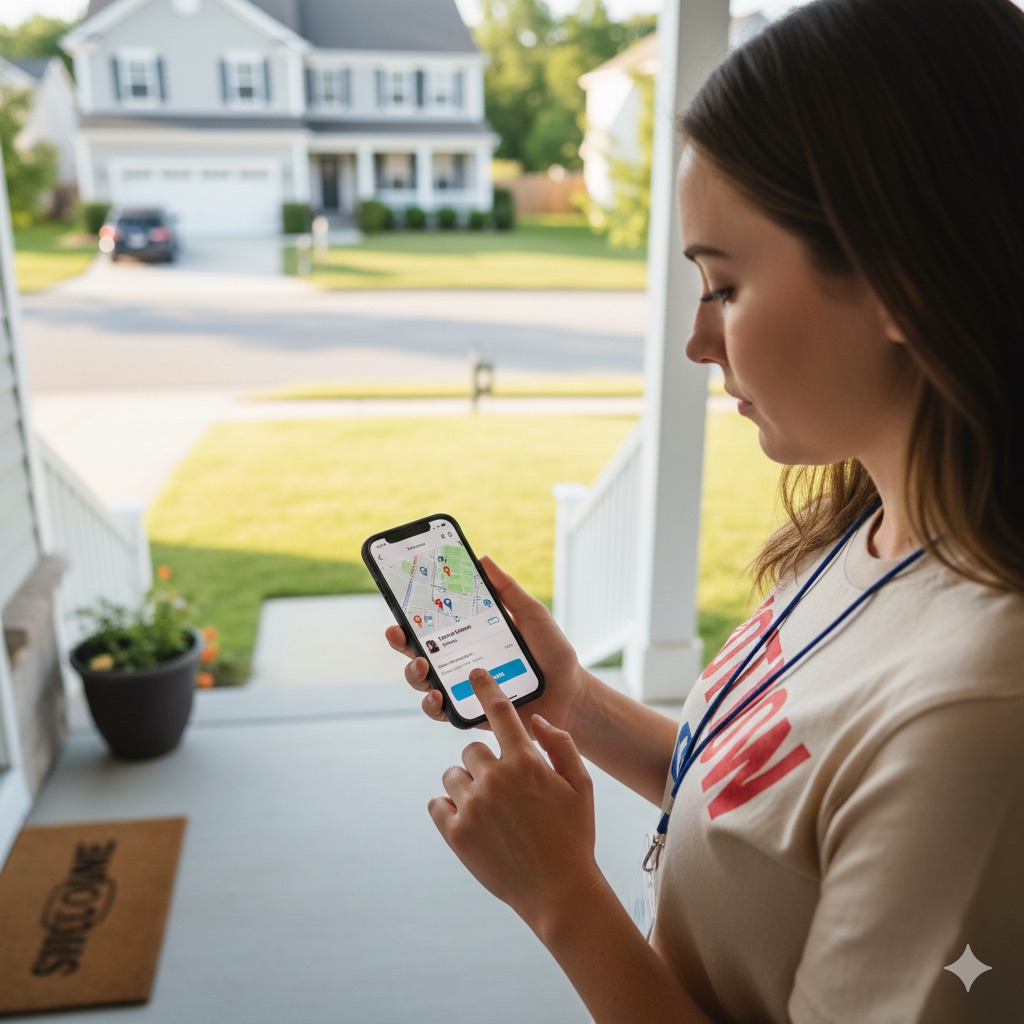
Key categories of political tech tools
When you're organizing, political technology tools fall into several key categories, each serving a distinct purpose in your campaign or movement:
Communication and outreach platforms
Phonebanking systems automate calling lists so volunteers spend more time talking to people and less time dialing. Most campaigns see volunteers complete 2-3 times as many conversations per hour as manual dialing.
Peer-to-peer texting lets organizers and volunteers send personalized texts to supporters or voters, making outreach scalable while remaining personal. These platforms allow you send thousands of initial texts quickly, then handle individual replies through honest conversations, with campaigns sending over 11.6 billion political text messages in just the last three months of the 2020 election.
Email marketing tools designed for campaigns handle mass communications while tracking open rates, click-through rates, and supporter engagement. Political email platforms often include features like A/B testing for subject lines and automatic list segmentation.
Data management and CRM systems
Voter databases store and manage supporter information, track interactions, and segment lists for targeted outreach. These systems are fundamental for relationship-building because they keep all supporter history in one place.
Contact management platforms track every interaction with supporters, from phone calls to event attendance to donation history. This comprehensive tracking helps organizers personalize future outreach and identify the most engaged supporters.
Analytics tools analyze supporter data to identify trends, measure engagement, and refine your organizing strategy. These tools help you target the right people with the right message by showing patterns in supporter behavior and response rates.
Fundraising and donation platforms
Online donation tools make it easy for supporters to give online, reducing barriers to contribution and expanding your donor base beyond major gift prospects.
Peer-to-peer fundraising platforms enable supporters to create their own fundraising pages and ask their networks to contribute, multiplying your campaign's reach through personal relationships.
Recurring donation systems allow supporters to set up monthly contributions, creating more predictable revenue streams for ongoing campaigns and organizations.
Event management and volunteer coordination
Event management platforms handle registration, attendance tracking, and follow-up communications for everything from house parties to large rallies.
Volunteer management systems recruit, train, and coordinate volunteer teams while tracking their contributions and recognizing their efforts.
Scheduling tools allow supporters to sign up for volunteer shifts, attend events, or schedule one-on-one conversations with organizers.
How technology has reshaped campaigns
Political technology has fundamentally changed how organizing works. The transformation goes beyond just making existing tasks faster; it has restructured the entire approach to building movements and winning campaigns.
Scale and reach: Technology lets you reach thousands or millions of people quickly, far beyond what was possible with paper lists or door-to-door canvassing alone. A single organizer can now coordinate outreach to 10,000 supporters in the time it once took to call 100 people.
Speed and responsiveness: Real-time communication tools enable rapid responses to events, mobilizing supporters instantly. When breaking news affects your campaign, you can have a response email drafted, approved, and sent to your entire list within an hour.
Data-driven decision-making: Organizers can now track supporter engagement, measure impact, and adjust strategies based on real data. Modern platforms provide detailed analytics showing which messages generate the highest response rates, which volunteers complete the most calls, and which outreach methods convert supporters into active participants, with studies showing texted voters turning out 0.7 percentage points more than untexted counterparts.
Accessibility and inclusion: Digital tools lower barriers to participation, allowing more people to get involved regardless of location or schedule. Volunteers can join phone banks from home, supporters can attend virtual events across time zones, and organizers can coordinate activities without requiring everyone to be in the same physical space.
The combination of scale, speed, data, and accessibility has created new possibilities for grassroots campaigns to compete effectively with well-funded opposition while building deeper relationships with supporters, enabled by platforms that scaled from 100 to 1,300 campaigns in just two years.

AI and emerging innovations in political tech
Political technology continues evolving with new innovations that can enhance your organizing when used thoughtfully:
Predictive analytics uses data to forecast which supporters are most likely to take action or vote, allowing you to focus resources where they'll have the most impact. These systems analyze past behavior patterns, demographic data, and engagement history to score supporters on their likelihood to volunteer, donate, or turn out to vote.
Automated content generation helps create initial drafts of campaign messages, social media posts, and phone scripts that align with your campaign's key messages and tone. Some organizing teams report significantly reducing content creation time while maintaining message consistency across multiple communication channels.
Intelligent targeting algorithms help identify and prioritize outreach to key audiences, making your organizing more efficient. These systems can automatically create call lists prioritized by likelihood to answer, or identify which supporters in your database are most similar to your most active volunteers.
Chatbots and automated responses handle routine supporter questions instantly, freeing up organizer time for higher-value conversations. These work best for frequently asked questions about events, volunteer opportunities, or basic campaign information.
While these tools offer significant benefits, they come with important limitations. Algorithmic bias can perpetuate existing inequalities in outreach, potentially excluding communities that don't fit historical patterns of engagement. The risk of losing authentic human connection increases when automation handles too much supporter interaction.
Your organizing will be stronger when you use these tools thoughtfully, maintaining focus on building genuine relationships while leveraging technology to work more strategically.
Challenges and considerations in political tech
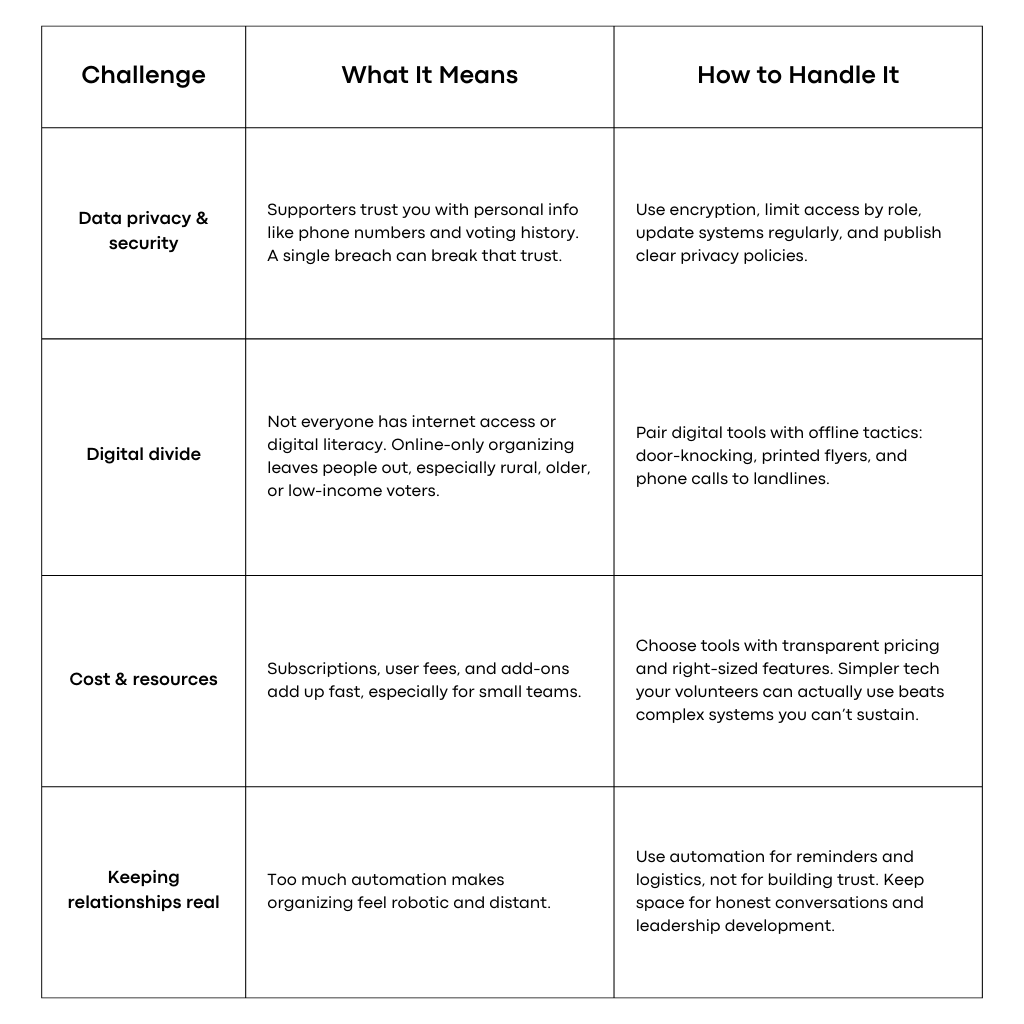
Using technology to organize people comes with trade-offs. The goal isn’t to avoid tech; it’s to use it responsibly, inclusively, and without losing the human connection that makes organizing work.
How Solidarity Tech Powers Modern Political Technology
Solidarity Tech demonstrates effective political technology through its comprehensive organizing platform explicitly designed for unions, advocacy groups, political campaigns and non-profits.
The platform addresses common organizing challenges through integrated tools that handle communication, data management, and volunteer coordination.
Communication and outreach capabilities
Predictive dialing for faster outreach: Volunteers reach more voters in less time with a predictive dialer that connects only live calls, no wasted minutes on rings or voicemails. It runs through a mobile app, so callers can work from anywhere and still keep the personal touch that makes phone conversations effective.
Texting that scales personally: The built-in texting platform handles both broad text blasts and one-on-one follow-ups in the same place. Every message comes from your organization’s number, keeping your campaign voice consistent no matter which volunteer replies.
Unified communication history: Every text, call, and email is automatically logged in the supporter’s profile. When someone calls back, organizers can instantly see their full history, from past conversations to events attended or donations made, allowing truly informed, personal follow-ups.
Data management and targeting
Unified supporter profiles: A good CRM keeps all your data (contacts, conversations, events, and actions) in one place. Every supporter has a single profile showing their full history: petitions signed, events attended, and notes from past calls or texts. No more scattered spreadsheets or lost context.
Smart audience filters: The query builder lets you target exactly who you need. You can pull lists like “everyone who attended an event in the past 30 days and speaks Spanish,” then use that same segment for emails, texts, or phone banks without rebuilding it each time.
Visual data insights: Wall Chart views turn your supporter data into clear, interactive visuals. You can see how people are distributed by region, language, or engagement score and spot where your strongest chapters or biggest opportunities really are.
Volunteer management and coordination
Role-based access: Each team member sees only what they need. Chapter leads can manage entire regions, while workplace or campus captains can access only their own lists. This keeps operations organized and supporter data secure.
Team activity tracking: Leaders can see how many calls, texts, or follow-ups each volunteer completes, and spot who might need extra coaching or support. Reports show average call times, missed contacts, and engagement levels to help teams improve performance week by week.
Scheduled conversations: Supporters can book one-on-one calls with organizers at times that work for them. The system sends automatic reminders, tracks completed calls, and measures call quality, helping campaigns maintain consistent, personal engagement at scale.
Event and chapter management
Coordinated multi-session events: From workplace meetings to national conventions, event tools handle registration, reminders, and attendance tracking in one place. Attendees automatically receive calendar invites with directions or Zoom links; no separate follow-up needed.
Organized by chapters: Unions and advocacy groups can structure their work by region or focus area. Each chapter has its own phone number and customizable communication templates, keeping local teams flexible while maintaining a unified organizational voice.
Geographic branch mapping: Supporters are automatically assigned to local branches based on postal codes, making hyper-local organizing easy. Visual mapping tools let teams adjust boundaries or create custom regions to match real-world communities and organizing goals.
The platform operates on transparent pricing starting at $29 per month for small organizations, with unlimited users and no per-seat fees that can limit volunteer participation. Organizations interested in seeing these tools in action can schedule a demo.
Best practices for implementing political tech
When you're ready to adopt political technology, following proven strategies helps ensure successful implementation and maximum impact for your organizing efforts.
Start with clear goals and a needs assessment. Identify the specific challenges you want technology to solve before evaluating platforms. Map your current organizing workflow and document where your team spends time on repetitive tasks, where information gets lost between team members, and where bottlenecks slow down your outreach efforts.
Choose tools that match your team's capacity. Consider your budget constraints, your team and volunteers' technical comfort level, and how new tools will integrate with the systems you already use. Campaigns achieve higher adoption rates when technology aligns with their team's existing skills and preferences, rather than requiring extensive training.
Plan for training and support. Set realistic timelines that account for the learning curve and avoid launching new systems during high-pressure campaign periods. Create training materials in multiple formats to accommodate different learning preferences, and designate team members who can help others troubleshoot problems.
Implement gradually and measure results. Start with one specific challenge your campaign faces regularly rather than trying to transform everything at once. Track key metrics that directly relate to your organizing goals, like outreach completion rates, volunteer retention, and supporter response rates.
Maintain focus on relationships. Use technology to identify opportunities for personal outreach rather than replacing human contact with automated interactions. The most effective campaigns use digital tools to support strategic relationship-building while preserving space for the conversations that create lasting change.
Evaluate and adjust regularly. Schedule monthly check-ins to evaluate whether your technology choices are working and make adjustments based on real usage patterns. Collect feedback from volunteers and staff about what creates value and what causes frustration.
Political technology works best when it amplifies your organizing strategy rather than dictating it. Keep relationship-building and power analysis at the center of your approach, using digital tools to scale what already works in your organizing model.
Frequently asked questions about political technology examples
What political technology tools do small campaigns need most?
Keep it simple. You don’t need a dozen platforms, just the ones that help you stay organized, talk to supporters, and raise money.
Contact management: One place to track everyone you talk to, voters, donors, and volunteers.
Communication tools: Phonebanking and P2P texting help you reach people fast without burning out your volunteers.
Online fundraising: Easy donation pages that automatically log contributions so you don’t have to update spreadsheets at midnight.
If you have these three covered, you’ve got the foundation to run a real campaign, even on a small team.
How much do political technology platforms typically cost?
It depends on your size and the amount of outreach you’re doing.
Small local races can usually get by with $75-$150/month for basic contact management and messaging tools.
Mid-sized campaigns spend around $200-$400/month for automation and better reporting.
Big, ongoing operations with thousands of supporters often invest $500- $1,000/month in analytics, integrations, and full support.
The key is to start where you are and scale up when the work demands it, not before.
Can political technology replace traditional organizing methods?
No chance. Tech can make you faster, but it can’t build trust. Tools are available to handle admin work (scheduling, data entry, reminders), so people can focus on organizing. The real power still comes from conversations, relationships, and leadership. The best campaigns use both: tech for efficiency, people for persuasion.
read more
Explore More Political Campaign Insights
From voter mobilization to digital outreach and field organizing, explore proven strategies and tools to run winning political campaigns.
/m1536k18ijfwtgg10biudci7ur5y)
Voter Engagement Strategies to Turn Supporters Into Voters
/nvtb1ztgqz6qadhrema15msrps37)
How to Run a Political Campaign and Build Winning Coalitions
/97f43dwxyub38v7k76k22ggeqc1b)
What is the Best CRM For Political Campaigns?
/6srh31v0w75qax1rynr7cv8cgk6y)
What is Political P2P Texting? Key Insights for Campaigns
/x0qhqr15630l05tvvhcl6ppmg2tx)
What is Voter Mobilization and How to Build Winning Campaigns
/gp53kbes5kisj2mnnsbpnfsyc4k8)
How to Build Political Campaign Websites That Win Support
/yvs8804s2np341r1w5cqa16t76tz)
How to Use Political Outreach for Stronger Campaign Engagement
/cp066p6lkgj6ufurlwfpwfznh2fp)
What is Political Phone Banking? How Campaigns Build Power