/aae4r3zbfjp61nkcgf3iuobi8los)
/k33k6ok5k5vx3wpve9qkm968omud)
Content
Political phone banking increased the probability of voting by approximately 3.8 percentage points in a Yale GOTV experiment (N=26,974), indicating that campaigns have a strong incentive to call as many people as possible.
But there's a catch: TCPA compliance for political phone banking carries genuine legal and financial stakes, and "we're a campaign, so the rules don't apply to us" ranks among the costliest myths in political organizing.
Understanding TCPA Compliance in Political Phone Banking
The Telephone Consumer Protection Act (TCPA) is a federal law restricting unsolicited calls and texts. It applies to political campaigns, PACs, Super PACs, and 501(c)(4)s, not just commercial telemarketers.
Many organizers assume their campaign is exempt. It's not. According to the FCC's consumer guide on political robocalls, the same statutory framework that governs commercial callers governs political operations, with a narrow set of exemptions that don't eliminate the Act's foundational requirements.

What Is the Statutory Violation Range for TCPA Violations?
TCPA violations carry fines of $500 to $1,500 per call or text. Willful or knowing violations are automatically trebled to $1,500 per contact. At 10,000 outbound contacts, that's $15 million in potential exposure. State laws layer on top of federal rules and sometimes carry additional civil remedies; your total exposure can exceed the federal baseline.
Class-Action Liability Exposure for Political Campaigns
Class actions are where TCPA liability becomes existential. A single improperly dialed list of cell phones without consent can generate a class of thousands. Courts certify these cases because the per-violation amount is fixed and individual damages are small. According to Mac Murray & Shuster LLP's TCPA political calling guide, class-action attorneys actively monitor political campaigns for ATDS use on wireless numbers without consent. Don't treat this as theoretical.
What Constitutes an Automatic Telephone Dialing System (ATDS)?
The ATDS definition sits at the center of almost every TCPA dispute involving political phone banking. Get this wrong, and you've exposed your entire calling program.
Legal Definition and Court Interpretations of an ATDS
An ATDS is any system that uses a random or sequential number generator to store or produce numbers and then dials them. The Supreme Court's 2021 decision in Facebook v. Duguid narrowed the definition, but circuit courts continue interpreting the boundaries differently. As the National Consumer Law Center's 2025 analysis notes, what counts as an ATDS in one federal circuit may not in another. National campaigns face real compliance uncertainty.
How Courts Distinguish Manual Dialers from Systems Meeting the ATDS Threshold
A system that automatically dials numbers from a stored list without human intervention on each call likely meets the ATDS threshold. A system where a volunteer clicks "call" to initiate each individual call is far less likely to qualify. The practical line is human agency at the moment of dialing. If a volunteer is making calls through phone banking software that requires them to press a button before each call connects, that's markedly different from predictive dialing to cell phones without consent.
1. Obtaining Prior Express Written Consent Before Calling
Consent is your biggest compliance variable in political phone banking. What you need depends on your technology and who you're calling.
What Is the Difference Between Prior Express Written Consent and Standard Express Consent?
Prior Express Written Consent (PEWC) is a signed agreement (physical or electronic) that clearly authorizes autodialed or prerecorded calls or texts to a wireless number. Standard express consent? Lower bar entirely: the person gave their number in a context implying they want to be contacted by your organization. You don't need the written form for standard consent, but proof of how and when consent was given still matters for your legal defense.
When Is Prior Express Written Consent Required?
PEWC is required when you're sending autodialed or prerecorded calls to a wireless number. If your predictive dialer is touching cell phones, you need PEWC from each recipient before that call goes out. Prerecorded voice messages sent to cell phones? Same rule. No PEWC, no autodialed call to that number.
When Is Standard Express Consent Sufficient for Political Outreach?
Standard express consent covers informational texts, peer-to-peer texts, and live calls placed without an ATDS to wireless numbers. A voter fills out your volunteer signup form and gives you their cell number; that's generally standard express consent for live P2P outreach. Here's the thing: providing a phone number to register to vote doesn't constitute consent to political callers.
Documentation and Written Consent Formats Required for TCPA Audit Defense
Acceptable PEWC formats include web form checkboxes with clear disclosure language, signed paper forms, and recorded verbal agreements where the caller reads a consent script. Four-year minimum retention period for consent records (the TCPA statute of limitations). If a voter claims they never consented, you need dated, documented proof. Your CRM's consent records and form submission logs are your first line of defense; Solidarity Tech's CRM automatically tracks consent and form submissions, so audit records don't require manual reconstruction.
2. Respecting the National Do-Not-Call Registry
The DNC Registry is massive. The FTC reported 258 million active DNC registrations in 2025. And the rules for political callers are different.
Are Political Calls Exempt from the National Do Not Call Registry?
Yes. Political campaign calls and texts are exempt from the National Do Not Call Registry requirements. Your campaign doesn't need to scrub voter lists against the federal DNC database before calling. This is one genuinely favorable carve-out for political operations under federal law, and it applies to candidates, PACs, and issue advocacy organizations.
Must Campaigns Maintain Internal Do-Not-Call Lists Despite Federal DNC Exemption?
Yes. The federal DNC exemption doesn't mean you can ignore voter opt-outs. Campaigns must maintain internal do-not-call lists and honor every opt-out request. When a voter says "don't call me again," that person goes on your internal suppression list immediately. Failing to honor opt-outs after the fact is a TCPA violation regardless of your political exemption status.
3. Avoiding Autodialed and Prerecorded Calls to Cell Phones
This is where most political phone banking violations happen. Cell phones carry strict consent requirements regardless of whether you're a campaign or a corporation.
What Consent Is Required for Autodialer Calls to Wireless Numbers?
Calling or texting a wireless number using an ATDS or prerecorded voice requires prior express consent. For political calls, this is a slightly lower standard than the prior express written consent required for marketing, but consent must still exist and be documented before the call goes out. Without it? Each autodialed call to a cell phone is a standalone TCPA violation.
Why Is Manual Dialing of Cell Phones Recommended Over Autodialers?
If volunteers are manually dialing telephones, the TCPA likely doesn't apply. That's the safe harbor. Manual dialing (a human clicks to call each number individually) takes the ATDS question off the table entirely. For cell phone outreach, peer-to-peer phone banking where each volunteer initiates each call is the lowest-risk approach. It's slower per hour than predictive dialing, but it avoids the consent requirements that make autodialing cell phones legally treacherous.
4. Understanding Political Exemptions and Limitations
Political campaigns have some genuine exemptions. They also have real limits. Knowing the difference protects you from assuming you're covered when you're not.
Do Campaigns Need Consent for Manual Dialing to Residential Landlines?
No. Manually dialing landlines requires no prior consent. And autodialing landlines for political purposes is generally allowed without consent. But prerecorded messages to residential landlines are capped at three calls within any 30-day period without prior consent, per FCC guidance on political robocalls.
What Restrictions Apply to Prerecorded Voice Messages to Landlines?
Prerecorded political robocalls to landlines must provide an interactive opt-out mechanism. The message must include a way for the recipient to signal they don't want future calls, either through an automated keypress option or a callback number. Robocalls that don't include this interactive requirement violate the TCPA even on landlines.
Exceptions and Safe Harbors for Political Calls, Including Candidate-to-Voter Direct Calls
Candidate-to-voter direct calls where the candidate personally makes live calls don't trigger ATDS concerns (no automated system involved). Some courts have also recognized a safe harbor when calls are placed for purely informational, non-commercial purposes without automation. But mix any commercial message into a political call, and you strip the political exemption; the call becomes subject to full commercial TCPA rules.
5. Providing Clear Identification and Callback Information
Every political call and text must identify the organization sending it. This isn't negotiable, and it applies to live calls, robocalls, and SMS outreach.
For live calls, the caller must state the name of the individual making the call and the organization on whose behalf it is made at the beginning. For prerecorded messages, the same identification must appear at the start of the message, along with a callback telephone number during or after the message. SMS messages must identify the sender and include contact information. The FTC reported 2.6 million DNC complaints in FY 2025, and improper caller identification ranks among the most common complaint triggers. Failing to identify properly compounds your violation count; if the call also lacked consent, you're facing two per-call violations, not one.
6. Restricting Call Times to Compliant Hours
Federal TCPA rules restrict all phone banking to 8:00 a.m. through 9:00 p.m. in the recipient's local time zone. This applies to peer-to-peer texting and calling equally.
The local-time rule means a volunteer in California calling a voter in New York at 6:00 p.m. Pacific is reaching that voter at 9:00 p.m. Eastern. That's the edge of the window. Calls at 9:01 p.m. local time are violations. Your dialing system must enforce local time zones automatically; don't rely on volunteers to do this math.
How State-Specific Calling Curfews Differ Across Major States
Many states set more restrictive windows than the federal floor. Here's what you need to know:
State | Calling Window | Notes |
Federal baseline | 8:00 a.m., 9:00 p.m. | Recipient's local time |
Florida | 8:00 a.m., 9:00 p.m. | Mirrors federal; state law adds restrictions for certain call types |
California | 8:00 a.m., 9:00 p.m. | Plus all-party consent recording law |
New York | 8:00 a.m., 9:00 p.m. | Additional state telemarketing statute overlaps |
Illinois | 8:00 a.m., 9:00 p.m. | BIPA recording rules add separate compliance layer |
State laws can also impose additional time restrictions for specific election periods, so check current state statutes before each campaign cycle.
7. Maintaining Detailed Records of Consent and Opt-Outs
Good records don't just protect you in court. They make your day-to-day calling program run cleaner.
How Should Campaigns Handle 'STOP' Replies to SMS Messages?
"STOP" (and equivalents like "QUIT," "CANCEL," "UNSUBSCRIBE," "END") must be honored immediately. The FCC's consent revocation rule, effective April 11, 2025, requires that any "revoke all" instruction be processed across all communication channels, not just the channel where it was received. A STOP reply to a text must also suppress future calls. Honoring opt-outs in one channel but continuing outreach through another is a violation. Simple text replies are sufficient for voters to opt out; you don't require a formal written request.
Recordkeeping and Compliance Documentation to Defend Against TCPA Claims
Your records need to show four things: when consent was obtained, how it was obtained, what the person consented to, and when opt-outs were processed. The minimum four-year retention period covers the full TCPA statute of limitations. Store consent timestamps, form submission logs, opt-out logs with timestamps, and call records with outcomes. Solidarity Tech's CRM automatically logs every call, text, and form submission in each contact's activity timeline, which builds the audit trail campaigns need without manual data entry.
8. Complying with State-Specific Call Recording Laws
State regulations routinely impose rules stricter than the federal TCPA baseline. The FTC and 48 state AGs partnered with the FCC on TCPA enforcement, meaning state-level violations can trigger independent AG actions separate from any federal FCC or FTC proceedings.
How Do State Regulations Affect TCPA Compliance for Political Phone Banking?
The most consequential state-level issue is consent for call recording. Federal law requires only one-party consent to record a call. But California, Illinois, Florida (during certain call types), Washington, and several other states require all-party consent. Recording a call in a two-party consent state without telling the other party is a state-law violation, potentially a criminal one. Political campaigns that record calls for quality review or volunteer training must disclose the recording at the start of the call in all-party-consent states. This is a separate obligation from the TCPA identification requirement, though both can be satisfied in a single disclosure statement at the start of the call.
9. Implementing Technology That Enforces TCPA Rules
Technology is where TCPA rules are either enforced or broken. Manual compliance checks on a list of 100,000 contacts don't work; the system has to do it.
Compliance-enabling phone banking technology should do at least five things: validate phone numbers as mobile or landline before dialing, enforce local time-zone restrictions automatically, flag or suppress contacts who've opted out, maintain timestamped consent records, and distinguish between autodialed and manually initiated calls for ATDS purposes. The campaign data organization software in your CRM should validate every phone number on import, identifying mobile, landline, or VoIP, so your team knows which numbers require consent documentation before a call goes out.

Handling Numbers That Belong to Both Business and Personal Contacts
A number registered to a business doesn't get personal-use TCPA protections. But a number someone uses for both business and personal calls, with personal use as the main purpose, can still trigger wireless number consent requirements. The consent standard follows how the number is used, not how it's registered. Treat ambiguous numbers as wireless and document consent accordingly when in doubt. Your technology stack should allow you to tag contact numbers by type and apply the appropriate consent workflow.
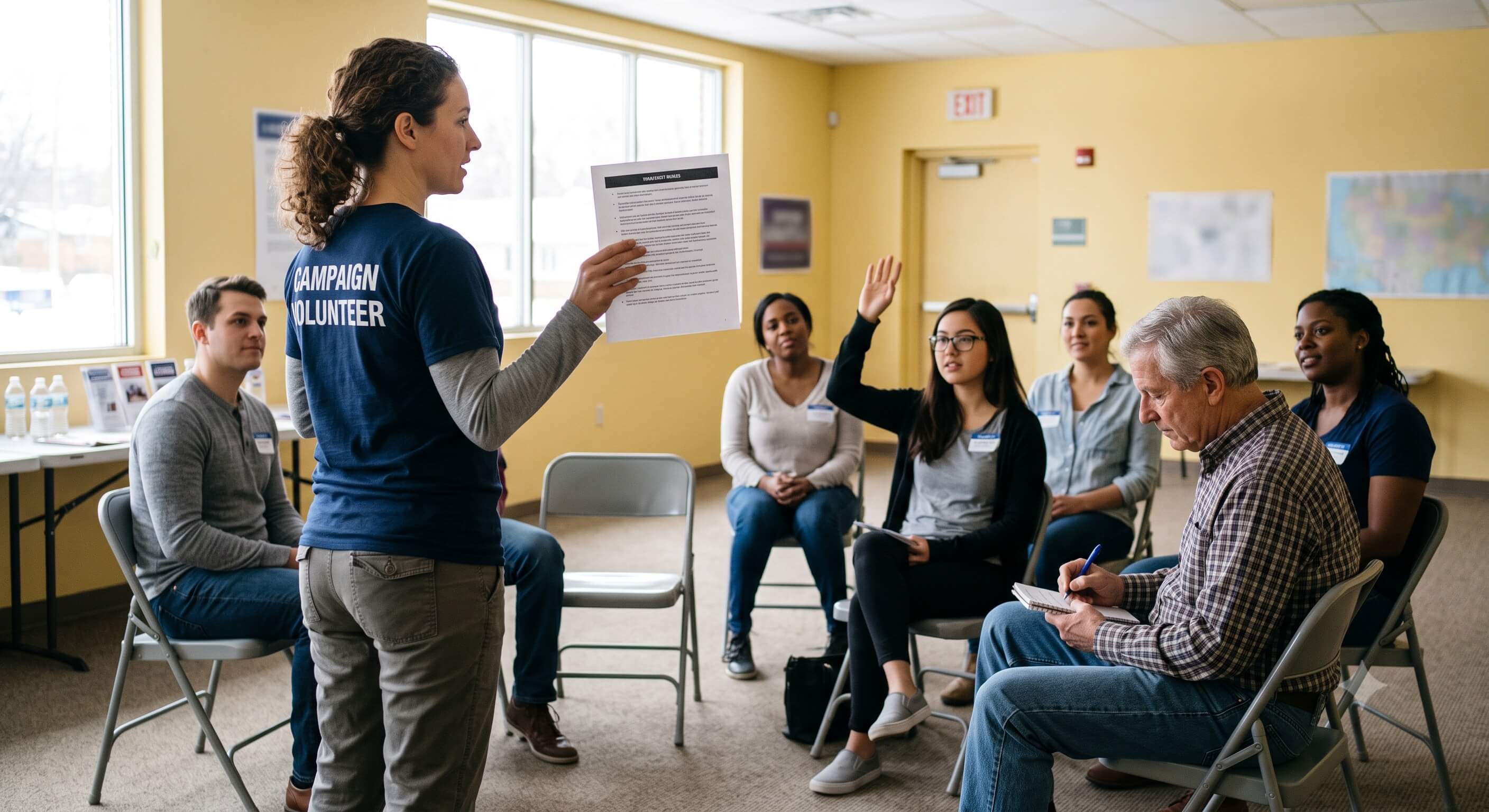
10. Training Staff on TCPA Violations and Penalties
Front-line volunteers are your biggest TCPA liability. They make the calls, handle opt-out requests, and sometimes go off-script in ways that lead to violations.
Training should cover the $ 500–$1,500 per-call violation structure so volunteers understand this isn't abstract. It should cover the PEWC vs. standard consent distinction; the opt-out handling procedure (stop immediately, log it, suppress across all channels); the call-time window and why local time zones matter; and what to say when a voter asks to be removed. Run a short script review that includes the identification disclosure. Test volunteers on how to handle "STOP" replies before they start texting.
The most common volunteer-driven violations are calling outside permitted hours, failing to log opt-out requests, and using lists for which consent status is unknown. Building a brief pre-shift checklist into your campaign volunteer management software workflow means these checks happen before calls go out, not after a complaint lands.
How Solidarity Tech Supports TCPA-Compliant Political Phone Banking
Compliance without the right tools is just good intentions. Solidarity Tech was built for exactly the kind of organized, relationship-based outreach that stays on the right side of the TCPA. The phone banking software includes three dialer modes: one-to-one calling (where a volunteer initiates each call manually, avoiding ATDS exposure on cell phones), a power dialer, and a predictive dialer for large-scale outreach, where consent is documented. Each mode matches a different compliance context.
The CRM automatically logs every call, text, and form submission with timestamps, building the consent records and opt-out trails you'd need to defend a TCPA claim. STOP replies and opt-out requests are captured in each contact's activity timeline.
The organizer experience and follow-up tools route incoming calls and texts to the right team member while maintaining centralized opt-out records, so a suppression request in one channel doesn't fall through the cracks in another.
And since Solidarity Tech is built for progressive campaigns and unions rather than generic commercial calling, the platform is designed around the consent-first, relationship-based outreach model that keeps political phone banking both compliant and effective.
Building a TCPA-Compliant Political Phone Banking Program
TCPA compliance for political phone banking isn't a one-time checklist. It's a program with four interdependent parts: consent capture, technology enforcement, recordkeeping, and training.
Consent capture means getting the right type of consent (PEWC for autodialed cell phone contacts, standard express for P2P outreach) before any call or text goes out, and documenting it with timestamps. Technology enforcement means your dialing system checks number type, enforces time zones, suppresses opted-out contacts, and distinguishes manual from automated calls. Recordkeeping means retaining consent records, opt-out logs, and call outcomes for at least four years. Training means every volunteer knows the $500-to-$1,500 per-violation structure; can handle a STOP reply correctly; and understands that opt-outs cross channels.
The 1,200 providers removed from RMD in 2025 showed how fast the FCC moves against non-compliant operators. Political campaigns aren't immune. Build the program before you build the call list, and you'll run the kind of operation that wins on the phones without creating legal liability.
Read More
Build a Political Phone Bank That Wins Elections
From voter ID calls to Election Day mobilization, explore the complete playbook for political voter contact by phone.
/wo1dm1x76a9s3procwou31aibnh8)
What is Political Phone Banking? The Complete Campaign Playbook
/h1in2ln469q6eyolsj75a11i6yhf)
How to Write Political Phone Banking Scripts That Work
/lpzogpqa47h2cgcw81q4oth6k61c)
How Predictive Dialers Work for Political Phone Banks: The Technology Behind the Calls
/um9596lo5bnhfxvc0e9ek5p9u65c)
What is Political GOTV Phone Banking? 7 Scripts That Drive Turnout
/qe0lh9yphqywkeuhlcn4ypyqep95)
What is a Virtual Phone Bank? How Political Campaigns Reach Voters