/tlsgme2vaq1slo5d3xl3du2qiw09)
/e90m9ybz83zca3yh6w5tvbwjgct4)
Content
You've run a phone bank. Volunteers show up, grab a list, dial, wait, disconnect from voicemails, stare at the ceiling. Somehow two hours evaporate into forty real conversations. Most of that time gets wasted on ringing phones.
Predictive dialers change the entire dynamic. They remove almost every dead second between conversations; the gap in voter contacts per hour isn't marginal. It's the difference between a competitive ground game and an exhausted volunteer crew that doesn't show up next shift.
What are Predictive Dialers in Political Phone Banking?
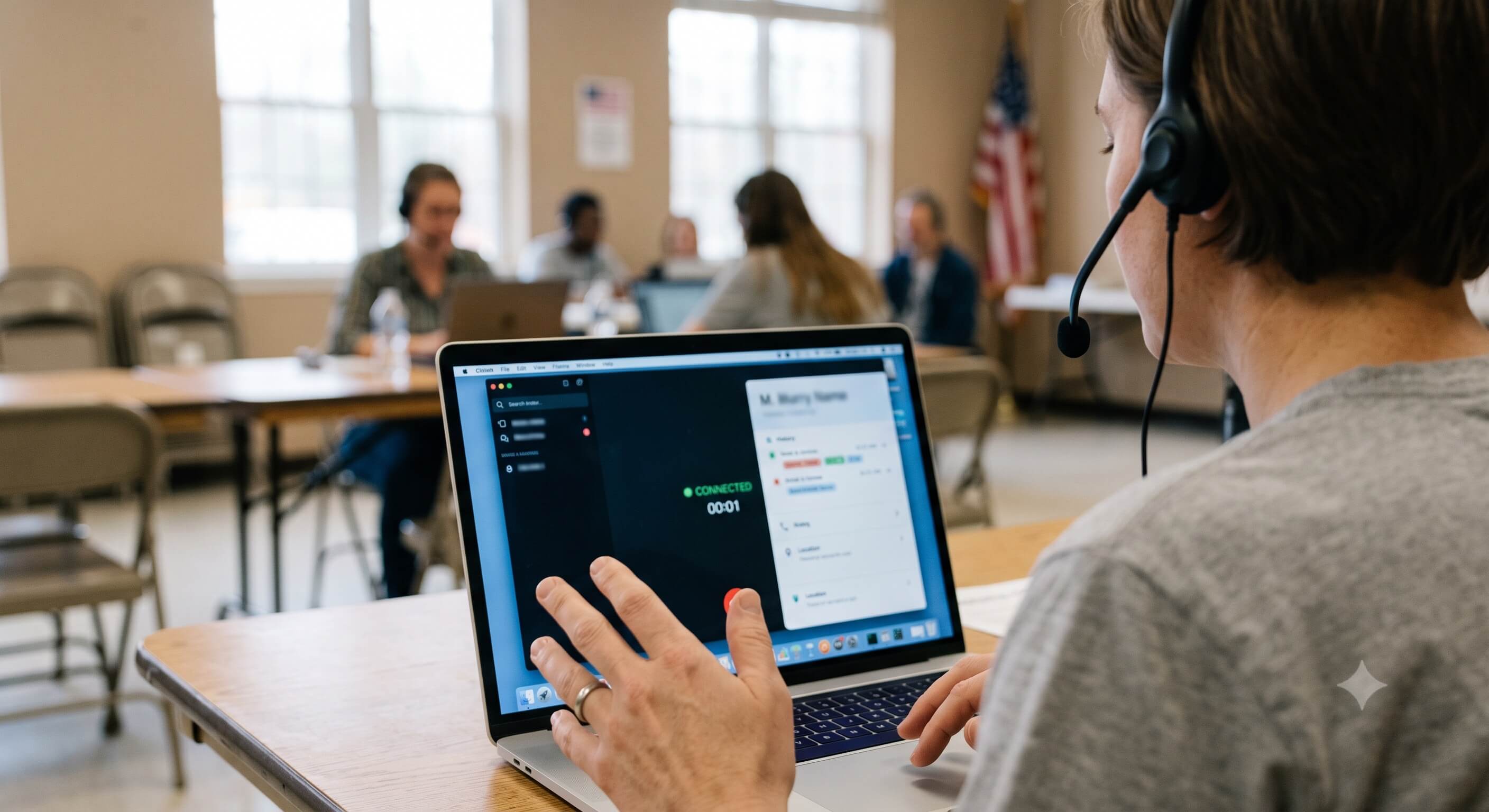
A predictive dialer is automated calling software that simultaneously dials multiple voter phone numbers while volunteers are still finishing current conversations, then routes only live-answered calls to an available volunteer. Political campaigns use them for voter outreach, GOTV mobilization, persuasion calls, and event RSVPs- basically any scenario where volume matters.
Definition and Purpose
Unlike manual calling, where a volunteer picks up and dials one number at a time, predictive dialers fire off multiple calls at once, predicting which ones'll connect with a live person right as a volunteer finishes. As one technical description puts it, predictive dialing systems predict when an agent becomes available rather than predicting when someone answers. The algorithm builds around the agent's schedule, not the voter's.

Components of a Predictive Dialer System
The main pieces: a dialing engine (handles call placement), a call progress analyzer (distinguishes live answers from machines), a routing layer (connects live calls to volunteers), and an agent interface (where volunteers read scripts and log outcomes). Everything sits on your voter contact list and feeds results back into your CRM in real time.
Scripting and Voter Data
Modern systems pull voter data- name, address, party registration, previous contact history- into the volunteer's screen the moment a live call connects. You'll notice the contact record appears before they say hello. Phone banking scripts can also adapt based on the voter's profile; soft supporters get persuasion language, confirmed ones get GOTV language.
How Predictive Dialers Work: The Technology Behind the Calls
The system dials multiple numbers per volunteer simultaneously and processes every call outcome before it reaches a human.
Dialing Algorithm and Pacing
The algorithm tracks how many volunteers are active, current answer rates from your voter list, and average call duration to decide how many lines to fire simultaneously. If your pool has a 60% answer rate and calls average 90 seconds, the algorithm dials enough lines in parallel to keep every volunteer busy the moment they're free. This pacing ratio shifts constantly. Answer rates drop mid-session? The system dials more lines to compensate.
Call Routing and Agent Assignment
When a call connects, the system routes it to the next available volunteer in milliseconds. Auto dialer systems fall into three categories: preview, power, and predictive, with predictive offering the fastest call completion because it queues calls before the volunteer's even ready to receive them.
Answer Detection and Call Classification
Every outbound call gets classified before a volunteer hears it. Busy signals, disconnected numbers, fax lines- all dropped instantly. Live answers route to volunteers; unanswered calls roll into the voicemail detection layer.
Voicemail Detection: Audio Analysis and Machine Identification
The system analyzes audio patterns, beep tones, recording-machine greetings, and speech-duration thresholds to identify answering machines. When detected, it can leave a pre-recorded message automatically and move on. Volunteers stay off the phone. Here's the thing: false positives happen. A voter who pauses at the start of their greeting is misclassified as a machine, resulting in a dropped call from their perspective.
Dead Air: Causes, Frequency, and Impact on Voter Response
Dead air is the silence a voter hears between picking up and the volunteer saying hello. It's baked into predictive dialing. The system connects the call before a volunteer's 100% ready, so there's a brief gap, typically one to two seconds, longer if pacing runs aggressive or volunteer staffing drops suddenly. That silence reads as suspicious to many voters. Studies on political calling show it meaningfully lowers response rates compared to calls where the volunteer speaks within the first second.
Predictive vs. Power Dialers: Which System Fits Your Campaign?
Both automate outbound calling; they make different trade-offs. Your choice affects volume, compliance exposure, and the volunteer experience every shift.
How Power Dialers Differ
A power dialer waits until a volunteer's free, then dials one number at a time. As the call center literature describes it: the volunteer clicks "next call" and the system dials. No multi-line prediction. Fewer abandoned calls, less dead air, cleaner voter experience. Trade-off: lower volume. Power dialers typically produce 40-60 calls per volunteer per hour; predictive dialers hit 80-120.
When to Choose Predictive Over Power Dialing
Factor | Power Dialer | Predictive Dialer |
Calls/hour per volunteer | ~40-60 | ~80-120 |
Abandoned call risk | Minimal | Requires active monitoring |
Volunteer learning curve | Low | Moderate |
Best for | Persuasion, relationship calls | GOTV, large-scale mobilization |
Compliance exposure | Lower | Higher (TCPA pacing rules apply) |
Need to contact 50,000 voters in three days? Predictive wins. Building 1-to-1 relationships with high-value supporters? One-to-one calling options may serve you better than either automated mode.
Volunteer Productivity: Why Predictive Dialers Increase Calling Output
The productivity gap between manual and predictive calling is where campaigns build momentum or burn out their teams.
Reducing Idle Time Between Calls
Volunteers making manual calls spend roughly 70% of their time on hold, ringing, and dialing. Predictive dialers flip that ratio, volunteers spend most of their time in actual conversations. Campaigns regularly report 3x more conversations per hour compared to manual methods. That's not just a volume number; it's a fatigue number. Volunteers who spend shifts talking feel more productive and return for the next shift.
Solidarity Tech's predictive dialer for political phone banks connects organizers only to live-answered calls. Volunteers can run the entire session from their phone without logging calls manually, because the CRM captures everything automatically.
Call Abandonment Rates and Mitigation
The FCC requires that no more than a 3% abandoned call rate limit be exceeded across all calls answered by a live person per 30-day campaign period. Breach that threshold and you're facing regulatory exposure and potential enforcement action. To stay compliant, campaigns monitor volunteer staffing in real time and throttle the dialing ratio if a sudden drop would push abandoned call counts past the cap.
Benefits of Predictive Dialers for Political Campaigns
Speed and volume get the headlines. But the actual picture is broader.
Volume and Speed Improvements
At 80-120 calls per volunteer per hour, compared to 15-25 with manual dialing, a ten-person phone bank using predictive tools matches a fifty-person manual operation in the same window. The global predictive dialer software market reached $3.20 billion in 2024, growing at a projected 42.3% annually through 2030, driven by exactly this productivity demand.
Informed Dialing Decisions
Every call outcome feeds your CRM. You can segment lists mid-session; if a neighborhood answers at a higher rate, the system prioritizes it. Volunteer performance reports show calls made, conversations completed, outcomes logged. Campaign managers see this in real time through organizing data and reporting tools and adjust staffing or list assignments before the session ends.
Cost Savings and Volunteer Management
Fewer volunteers to hit the same contact numbers means lower coordination overhead, less scheduling friction, more productive use of paid staff time. North America contributed 41.55% of global predictive dialer revenue in 2024, partly because TCPA compliance costs make fully manual campaigns increasingly untenable for large-scale operations.
Strategies to Improve Answer Rates
Pair predictive dialing with time-zone scheduling, calling voters in their local evening hours, typically 5-8 PM, and you'll see meaningful improvements in live answer rates. Local presence dialing (displaying a local area code rather than out-of-state) lifts pickup rates too. Both strategies can be configured in your dialing parameters before each session starts.
Limitations and Challenges of Predictive Dialing Technology
The productivity gains are real. So are the limitations.
Call Quality and Dropped Calls
Dead air isn't just annoying; it trains voters to hang up. A voter picks up, hears silence for two or three seconds, assumes it's spam, and disconnects before the volunteer speaks. That's distinct from a dropped call where the connection fails. Dead air is a timing artifact of the predictive model itself. Its frequency rises when pacing runs too aggressive or volunteer counts shift mid-session.
Legal Considerations
Predictive dialers trigger the most complex part of TCPA compliance. The FCC's AI voice classified as prerecorded TCPA ruling in February 2024 means any AI-generated voice in your calling workflow requires prior express consent, regardless of how the call gets placed. And political robocalls aren't exempt from TCPA, a fact that surprises many campaigns hitting their first TCPA audit. You need to know what voice is on your calls before you dial at scale.
Volunteer Experience and Learning Curve
First-time predictive dialer users get startled by the pace. Calls come in fast, the dead air moment feels awkward, the script interface looks different from anything they've used. Training volunteers on why dead air happens and how to launch confidently into their greeting the moment the connection fires meaningfully cuts the dropout rate in early sessions. Volunteer management tools that guide new callers through each step reduce that friction considerably.
Legal Requirements for Political Predictive Dialing
Political campaigns occupy a specific legal zone, not fully exempt, not fully commercial.
TCPA Rules and Mobile Device Restrictions
The TCPA governs autodialed calls to mobile phones. Any campaign using a predictive dialer for political phone banks must have prior express written consent before placing autodialed calls to cells. There's no political exemption. STIR/SHAKEN authentication, which gets stripped at non-IP network points, is also a compliance factor now. Campaigns whose carriers don't have full STIR/SHAKEN attestation risk calls getting flagged as spam before they reach a voter.
Consent Requirements and Permitted Line Types
Predictive autodialed calls to residential landlines don't require prior consent for political campaigns, but the FCC caps frequency at no more than 3 calls per consecutive 30-day period to any single landline without consent. Mobile phones are different. Prior express written consent required. Period.
Penalties and Legal Consequences for Violations
TCPA violations carry statutory damages of $500-$1,500 per call, per person. At predictive dialer speeds, a compliance failure generates six-figure exposure in a single session. Consent revocation rules that went into effect 04/11/2025 require campaigns to honor do-not-call requests within 10 business days, and your dialer's suppression list must reflect those removals before the next session fires.

Setting Up Predictive Dialers: Configuration and Testing
Getting the system running the right way on day one saves weeks of firefighting later.
Integrating with Voter Contact Lists
Your voter file needs cleaning before it enters the dialer. Validate phone numbers (mobile vs. landline vs. VoIP), remove numbers on suppression lists, segment by time zone. A bad list fed into a predictive dialer generates bad answer rates, high abandonment, and compliance exposure simultaneously. Campaign data organization tools that validate phone numbers before import catch these problems at the front door rather than mid-session.
Configuring Dialing Parameters
Start your lines-per-agent ratio conservatively, 2:1 or 3:1 rather than jumping to 4:1. Monitor abandoned call percentages against the 3% cap throughout the session. If volunteer count drops (people stepping out, connection issues), throttle the ratio immediately. It's easier to dial up than to recover from an abandonment spike.
Monitoring and Adjusting Performance
Watch two numbers in real time: conversations per hour and abandonment rate. If conversations per hour drops without a corresponding dip in dials, your list quality may be the problem. And if abandonment climbs above 2%, reduce your lines-per-agent ratio before you breach the regulatory cap. Live dashboard tracking during a session gives you the visibility to catch both issues before they become either a campaign problem or a legal one.
Managing Callbacks and Voicemail Follow-Up
Voicemails left during automated sessions create a callback queue that campaigns frequently ignore. That's a mistake. Set up a workflow where no-answer contacts get a follow-up text or a manual callback within 24 hours. The workflow automation tools that trigger a text when no one answers, "Sorry we missed you, can we set up a time to chat?", turn dead dials into booked conversations. Callbacks from genuinely interested voters are often your highest-converting contacts.
Real-World Outcomes: Predictive Dialer Performance in Political Calling
Political campaigns report 3x more conversations per volunteer hour with predictive dialing compared to manual methods. But the more telling number is volunteer-hours-saved: a GOTV operation contacting 100,000 voters that'd require 500 volunteer-hours manually can get done in roughly 160-200 volunteer-hours with a well-configured predictive system.
Mamdani's 2025 New York City mayoral campaign mobilized over 95,000 volunteers and executed a calling program at a scale that wouldn't have been operationally possible without phone banking software supporting high-volume automated dialing. Campaigns that stack predictive dialer outcomes against power dialer benchmarks consistently find the 40-60% volume advantage of predictive holds up, but only when pacing, suppression lists, and volunteer training all dial in from session one.
The contact rate gap between a well-configured predictive operation and a manual one compounds across a campaign cycle. Two thousand extra conversations per week becomes a meaningfully different ground game by Election Day.
How Solidarity Tech Handles Predictive Dialing for Campaigns
Solidarity Tech builds its predictive dialer for campaigns directly into an all-in-one political campaign platform, organizing CRM, so there's no separate tool to configure, no API to jury-rig between your voter file and your dialer, and no seat-based pricing that punishes you for having a large volunteer team. The predictive dialer is part of the Professional plan alongside unlimited team members, AI call summaries, and transcripts- tools that matter when you're running sessions with 50 volunteers simultaneously.
Volunteers can join a phone bank session from their phone using a one-click magic link and start receiving live-connected calls within minutes. Call outcomes log automatically, suppression lists update in real time, and relational organizing tools handle voicemail drop and follow-up text triggers without requiring a separate workflow.
The platform is independently bootstrapped and free from private equity, with transparent per-use pricing and no hidden fees that show up after your first major calling push.
Conclusion
Predictive dialers work by solving one problem: idle time. The algorithm fires calls before a volunteer's free, routes only live answers, and handles every other outcome automatically, leaving your volunteers talking to voters instead of listening to rings. Understanding how predictive dialers work for political phone banks means understanding that trade-off between volume and precision, between speed and compliance, and between what the technology does automatically and where human judgment still matters.
Get the list clean. Configure the pacing conservatively. Train volunteers on the dead air moment. Monitor abandonment in real time. Do those four things and a predictive dialer becomes a genuine productivity multiplier for your campaign. Skip any one and the technology works against you.
Read more
Build a Political Phone Bank That Wins Elections
From voter ID calls to Election Day mobilization, explore the complete playbook for political voter contact by phone.
/tnzwh46dqlprgnsjtwbsknkj9u0i)
What is Political Phone Banking? The Complete Campaign Playbook
/5a6kjyaubnkb41y3xfsvxhx4m2vf)
How to Write Political Phone Banking Scripts That Work
/hognhtiqhk0kd1kif6yq5flzxjfv)
TCPA Compliance for Political Phone Banking: Rules, Laws & Best Practices Explained
/d3keb0bmp7hbhqwffjvft8naakch)
What is Political GOTV Phone Banking? 7 Scripts That Drive Turnout
/fzxezno2lm73tbz5juc7bxma55ej)
What is a Virtual Phone Bank? How Political Campaigns Reach Voters